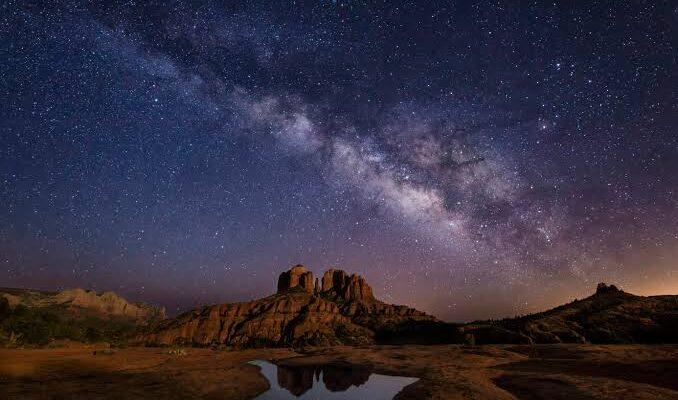
Have you seen countless perfect photos of the Milky Way on social media and thought it couldn’t be done in real life? It can. But only if you travel to a place where the triumph of civilization, with its streetlights, neon signs, and illuminated buildings, hasn’t yet reached.
Welcome to the world of astrotourism , one of the fastest-growing travel trends. Today, we’ll explain why the night sky has become scarce and where to find the brightest spots on the planet.
The problem of modern times: Where did the sky go?
Go out into the center of a large city at night. What do you see? The moon, a couple of bright planets, and a dozen of the most stubborn stars.
This is the result of light pollution . Excess artificial light creates a “dome of light” over cities, which dissipates in the atmosphere and completely obscures the light of distant galaxies and stars. According to statistics, approximately 80% of the Earth’s population lives under skies obscured by light pollution, and a third of humanity has never seen the Milky Way.
Astrotourists are travelers who set out in search of pristine darkness. After all, to see the universe as our ancestors saw it, we need to find places with zero or minimal light pollution.
How is darkness measured?
To assess the clarity of the night sky, astronomers and travelers use the Bortle Scale . It consists of nine levels:
- Class 1: Ideal dark sky (a real wilderness where the zodiacal light is visible and the Milky Way casts shadows).
- Class 4-5: Suburban or rural (stars visible but Milky Way dim).
- Class 8–9: City center (only the Moon, planets and brightest constellations are visible).
The goal of the astrotourist is to find class 1 and 2 locations.
Top Wild and Comfortable Darkness: The Best Places for Astrotourism
Atacama, Chile
The driest place on Earth and simultaneously a Mecca for global astronomy, the Atacama Desert is located at high altitude, with cloudless skies almost year-round and incredibly dry and clear air.
- Bonus: The region is home to the world’s largest ground-based telescopes, and many hotels offer tourists their own observatories and nightly lectures with professional guides.
Mauna Kea, Hawaii, USA
The dormant volcano Mauna Kea rises 4,207 meters above the clouds. Its summit boasts thin air and minimal humidity, creating ideal conditions for stargazing.
- Interesting fact: When descending the mountain at night, you should be careful when turning on your headlights so as not to interfere with the work of the giant observatories located at the peak.
Acadia National Park and Dark Sky Park, Isle of Skye, Scotland
If you don’t want to fly to another continent, there are also great destinations in Europe. For example, the Scottish Isle of Skye is famous for its remote, sparsely populated areas. And in the US, national parks like Acadia have official Dark Sky Park status , guaranteeing strict street lighting controls.
Putorana Plateau or Altai Republic
Russia has vast territories with zero light pollution.
- Altai is a classic Russian astrotourism destination. The mountains, pristine air, and remoteness from major cities create stunning views.
- The Putorana Plateau in the north of the Krasnoyarsk Territory is a wild, remote place where, in addition to the stars, you can catch the northern lights.
How to Plan an Astrotour: A Beginner’s Checklist
Use light pollution maps. Websites like Light Pollution Map (lightpollutionmap.info) will show you an interactive color-coded map of the world. Look for green, blue, gray, and black zones.
Keep an eye on the moon’s phases. The best time to observe deep space (galaxies and nebulae) is during the new moon . The bright full moon acts as a natural lantern, illuminating faintly luminous objects.
Check the weather forecast and cloud cover. Use specialized apps (such as Clear Outside ) that show not just rain, but also the transparency of the upper atmosphere and the presence of clouds at different altitudes.
Protect your night vision. The human eye requires about 20–30 minutes of complete darkness to fully adapt (“turn on night vision”). If you look at your smartphone screen at maximum brightness, you’ll have to start the process over again. Use red-light flashlights.
Astrotourism isn’t just a trip for the sake of taking beautiful photos. It’s a deeply meditative experience. Standing in the desert or mountains under billions of stars, you become acutely aware of the scale of the universe and your place in it.
Pack your backpacks, take warm clothes (it’s always cold at night away from the cities!) and head to where the city lights go out and legends shine.