
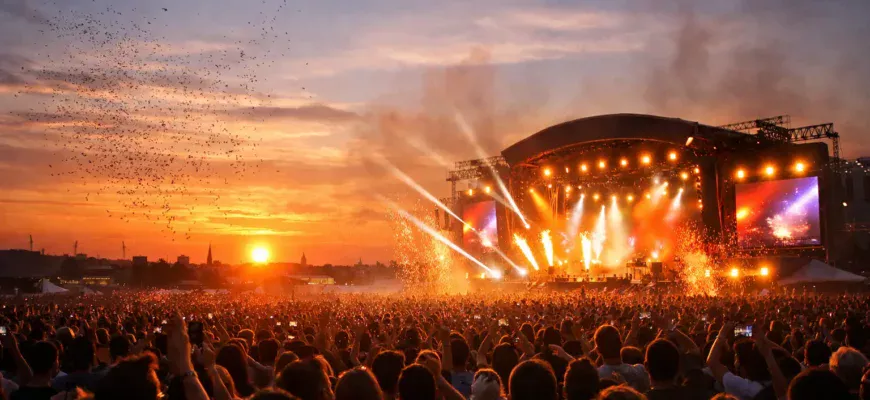
Imagine a city with a population of 100,000 that springs up in the middle of a field or park for just three days and then vanishes without a trace. It sounds like the plot of a science fiction movie, but for the festival logistics team, it’s a routine task.
Putting on a concert for a club with a capacity of 500 people is an art form. Organizing a city with a population of one million (by Icelandic or Liechtenstein standards) at a festival like Glastonbury, Coachella, or our major open-air festivals—is a masterclass in engineering, psychology, and precise planning.
Let's take a look behind the scenes and see how the invisible machinery that makes this celebration possible works.
The Golden Rule: Logistics Begin a Year Before the First Note Is Played
While the audience is dancing to their favorite song, the logistics team is already thinking about next year’s festival. Planning for a large-scale event begins 10–12 months in advance.
The first and most important consideration is the location. The field must be more than just beautiful. You need access roads for trucks (and there could be hundreds of them), a location far from residential areas (so as not to disturb local residents), soil that can withstand rain, and, of course, good transportation access.
Ant Farm: Delivery of Equipment and Stages
To build a city, you first have to bring it there.
- Tonnage: A large-scale festival requires between 150 and 300 heavy-haul trucks carrying equipment. Sound, lighting, screens, stage trusses, generators, portable toilets, fences, and food courts.
- Tetris on Site: Setup follows a strict schedule (timeline). Heavy equipment arrives first to level the ground and platforms; the artists and catering crew arrive last. A delay of even one day—or even one hour—can throw off the entire schedule.
No More Traffic Chaos: How to Get 100,000 Guests to and from the Event?
The most difficult challenge is to move a huge number of people from point A to point B without hours-long traffic jams and crowds.
- Multimodal Transportation: Organizers never rely solely on private cars. Temporary transfer hubs are set up. Shuttles run from the nearest train stations or major cities every 2–3 minutes.
- Traffic Management: Roads around the festival will temporarily become one-way. On opening days, traffic will flow only toward the festival; on closing days, traffic will flow only away from the festival.
- Giant Parking Lots: Laying out a parking lot for 20,000+ cars requires pinpoint accuracy. If the aisles are too narrow, a single stuck car will block the exit for thousands of people.
Essential Services: Water, Food, and Electricity
Over the weekend, 100,000 people consume as many resources as a small regional center.
- Power: Most campsites are not connected to the municipal power grid. The festival is powered by massive diesel generators (sometimes combined with solar panels), and cables are laid for kilometers, hidden in special cable trenches so that guests don’t trip over them.
- Water and Sewage: This is a topic that isn’t usually discussed in romantic accounts, but the event’s survival depends on it. Dozens of kilometers of water pipes deliver drinking water to fast-food stands and free water fountains. And waste removal and the emptying of portable toilets is a round-the-clock process that takes place at night while guests are sleeping or listening to the headliners.
Safety and Medicine
Security logistics involves not only the police and private security firms, but also the flow of people.
- Security Checkpoints and Screening: How can we get 100,000 people through security in the 4 hours before the headliner takes the stage? By increasing the number of screening lanes and implementing contactless ticket-scanning technology.
- Medical Care: Major festivals feature mini-hospitals equipped with intensive care units, doctors specializing in various fields, and helipads for emergency evacuations.
Perfect logistics are the kind you don't even notice
The main paradox of festival logistics is that the audience never gives it a second thought when everything goes smoothly.
If there’s cold water at the bar and toilet paper in the restrooms, the bus arrives on time, and the line to get in moves faster than the line for morning coffee at the office—then that means the army of logistics specialists, engineers, drivers, and volunteers has scored a perfect 10 out of 10.
And when, at the festival’s finale, thousands of paper confetti float up over the field, the logistical machine doesn’t stop: the dismantling process begins. In just a couple of weeks, the field will return to its original state, as if a city had never been there at all. Until next summer.