
Death and old age seem to us to be absolute laws of nature. “Everything in its time,” we say, observing the decay of nature and the human body. However, in the biological world, there are daring exceptions—creatures that seem to have cracked the systemic code of evolution and learned to live forever.
Today we’ll take a look into the laboratory of living nature and unravel the secrets of two of nature’s greatest immortal rebels: the tiny freshwater hydra and the amazing underground dweller, the naked mole rat.
Hydra: A significant understatement of death
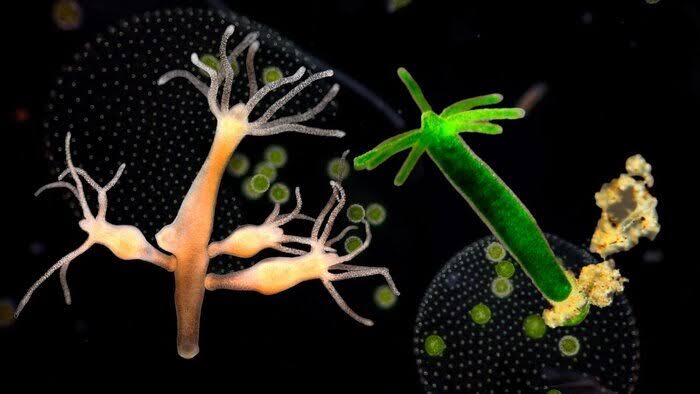
Let’s start with a classic. Imagine a tubular, gelatinous creature a couple of centimeters long, living at the bottom of a pond. It has no brain, no heart, no circulatory system. But it does have what alchemists of all times have dreamed of: absolute biological immortality.
As early as the 18th century, scientists noticed that the hydra doesn’t die of old age. Unless it’s eaten by a predator or becomes ill, it can live forever. So what’s the secret?
The Hydra’s secret lies in its stem cells. In humans, stem cells become depleted with age, losing their ability to divide and regenerate tissue. For the Hydra, this process works differently: its body is composed of stem cells that are in a constant, endless cycle of renewal. Every few weeks, the Hydra completely “changes its wardrobe,” replacing old cells with new ones. It has no aging program (senescence). Death from old age is not genetically programmed for the Hydra.
Naked mole rat: the rodent that forgot to age
If the hydra seems too primitive (it’s a coelenterate, after all), the second hero of our article is a fully-fledged mammal, a warm-blooded animal with fur (albeit barely visible) and a complex nervous system. Meet the naked mole rat.
These blind, pink creatures live underground in colonies similar to bee colonies. But their main advantage isn’t their social structure, but their phenomenal longevity. The size of a typical mouse, which lives for about two years, naked mole rats live to be over 30 years old . Moreover, scientists have observed a paradox: the naked mole rat’s mortality rate doesn’t increase with age. At 20, they are just as active, fertile, and healthy as they were at two. They virtually never develop age-related diseases, including cancer.
How do they do it? Nature has endowed mole rats with a whole arsenal of superpowers:
- Cellular immunity to cancer. Mole rats produce a special hyaluronic acid with a high molecular weight. When cells begin dividing too rapidly (which leads to tumor formation), this acid signals, “Stop! There’s no room.” Tumors simply cannot form.
- Perfect proteins. Their ribosomes (protein factories) work with incredible precision. Errors in protein synthesis are tens of times less common in mole rats than in humans or mice.
- Resistance to pain and hypoxia. They are immune to certain types of pain (such as acid burns) and can survive for up to 18 minutes with almost no oxygen in their sweltering underground tunnels.
What can we learn from them?
Studying hydras and naked mole rats isn’t just zoological curiosity. It’s a hope for humanity.
Of course, it’s unlikely we’ll become immortal in the coming centuries: human genetics is too complex, and evolution has programmed us to pass on genes to our offspring, after which the body becomes “ballast.” However, understanding how the hydra endlessly renews its tissues and how the mole rat protects its genome from mutations and cancer is already helping scientists develop new therapies for age-related diseases.
Perhaps by unraveling the mysteries of these amazing creatures, we won’t abolish death entirely, but we’ll certainly learn to prolong youth. For now, let’s admire the serenity of the immortal hydra and the resilience of the underground rebel, the naked mole rat.