
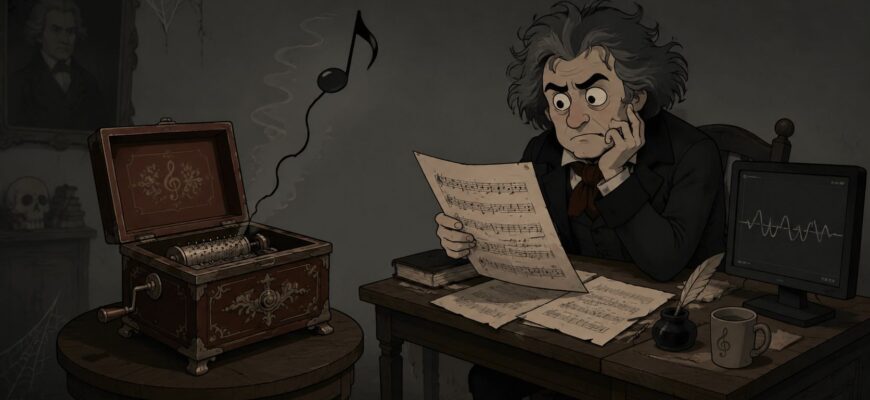
Imagine a classic horror film without the music, creaking floorboards, the unsettling rumble in the background, and sudden sound bursts. Chances are, much of the fear would simply disappear. The interesting thing is that audiences rarely notice the sound designer’s work. Their attention is focused on the monsters, actors, and special effects, while the soundtrack subtly manipulates our emotions.
A good horror film is like a magician. While the viewer is looking in one direction, the real magic is happening in another. Sound can make the body react to a non-existent danger faster than logic can explain it. “Oh, I imagined it!” we think. But our pulse has already quickened, our palms are sweating, and our muscles are tense.
Modern horror sound design is a complex combination of psychology, acoustics, musical composition, and human physiology. What’s more, it’s often not the loud sounds that are frightening, but rather the almost inaudible details that the brain registers somewhere on the periphery of perception.
Why is sound more frightening than a picture?
Vision is considered our primary source of information, but hearing has played an equally important role in evolution. Even thousands of years ago, an unusual rustling sound in the dark could signal the approach of a predator.
Our brain still operates according to the same basic algorithms. While the visual system allows us to examine an object and draw conclusions, the auditory system constantly scans the space for potential threats. This is why an unexpected sound can frighten a person even when they know perfectly well they’re at home on the couch watching TV.
Another interesting thing is that while you can close your eyes, it’s much more difficult to completely turn off your hearing. Even in sleep, the brain continues to analyze surrounding sounds. Therefore, auditory stimulation is often more direct and instinctive.
Horror creators are well aware of this feature and actively use it to create tension.
The Art of Anxious Anticipation
The greatest fear often arises not when the monster appears, but when the viewer only suspects its presence.
Let’s say a character is walking down a long, empty corridor. Almost nothing happens onscreen. However, a barely perceptible low-frequency hum appears in the background. The viewer may not even be aware of it, but the brain is already receiving a signal: something is wrong.
At this moment, the danger expectation mechanism is launched.
Sound designers call this approach “tension building.” Instead of outright startle, they gradually build discomfort through the sound environment.
The most common techniques are:
- low humming tones;
- gradually increasing noise;
- repeating sound patterns;
- unnatural acoustic effects;
- sounds whose origin cannot be determined.
Humans dislike uncertainty. When the source of a sound remains unknown, the imagination begins to construct the most frightening scenarios.
Infrasound: horror story or reality?
Infrasound remains one of the most discussed topics in the horror industry.
Infrasound refers to acoustic vibrations with frequencies below approximately 20 Hz, below the range of human hearing. Research has shown that exposure to such low frequencies can cause feelings of anxiety, restlessness, and physical discomfort in some people. Researchers from the UK, in an experiment involving a concert performance, noted a link between infrasound and unusual emotional sensations in some participants.
However, there are many myths surrounding infrasound. Some internet legends claim that it can literally cause panic. In reality, the scientific evidence is much more cautious. The effect does exist, but it’s nowhere near as mystical as the tabloid press likes to portray.
However, in the film and gaming industries, very low frequencies are indeed used to enhance emotional impact.
Silence as the most terrible weapon
It’s ironic, but sometimes the best sound for a horror film is no sound.
Many aspiring directors try to fill every frame with music or sound effects. Experienced filmmakers do the opposite. They know that silence creates the perfect breeding ground for fear.
When a familiar background sound suddenly disappears, the brain begins searching for an explanation. Tension builds. It feels like something terrible is about to happen.
This technique is especially effective before a so-called jump scare. The viewer senses an unnatural pause and intuitively anticipates the threat, although they don’t know exactly when it will appear.
This is why scenes of absolute silence are often more frightening than the loudest moments of a film.
Why do creaks and whispers cause goosebumps?
There are sounds that seem to be made for horror.
The creaking of doors, slow footsteps from above, distant whispers, scratching on the wall, children’s laughter in an empty room – all these elements are regularly found in horror films for a reason.
The fact is that such sounds have several common features:
- it is difficult to determine the exact location of the source;
- it is difficult to predict further developments;
- they resemble real household noises;
- contain frequency characteristics that the brain perceives with caution.
Whispers are especially interesting. When someone speaks very quietly, our brain automatically tries to “eavesdrop” on the conversation. Our attention is focused on the sound, and our anxiety levels increase.
It’s no wonder that many cult horror films use barely audible human voices instead of traditional musical themes.
Invisible Sounds and the Uncanny Valley Effect for Hearing
Most people have heard of the visual effect of the “uncanny valley.” This is a situation where an object appears almost human, but slight deviations cause discomfort.
A similar effect exists in the field of sound.
For example, the human voice can be slightly distorted by digital technology. The words will sound familiar, but something will remain off. So off that the viewer will begin to feel an inexplicable uneasiness.
This technique is often used to create voices:
- ghosts;
- demons;
- creatures of unknown origin;
- possessed characters;
- artificial intelligence in horror games.
The brain is excellent at recognizing human speech. But when the familiar sound pattern is disrupted, a sense of danger arises.
Sound Design in Video Games: Fear Under Player Control
In films, the director has complete control of the scene. In games, the situation is much more complex.
The player can stop, turn around, or explore the location at will. Therefore, sound designers must create dynamic sound systems.
Imagine an abandoned hospital in a horror game. While the character stands still, the only sounds are dripping water and the ventilation system. As soon as the player opens the door, the soundscape changes.
Added:
- echo reflections;
- distant steps;
- electrical interference noise;
- metal impacts;
- spatial sounds beyond the line of sight.
This approach creates a sense of lived-in space. The player feels as if a threat is nearby, even if the enemy isn’t actually there.
This is why many people consider some horror games to be scarier than movies.
How are monster sounds created?
Perhaps one of the most interesting aspects of sound design involves creating the monsters’ voices.
It’s rare for a monster to use a pre-recorded recording of a real animal. Typically, the sound is pieced together from dozens of different sources.
For example, for one creature the following can be mixed:
- The roar of a tiger.
- The creak of metal.
- Slow motion human scream.
- Engine sound.
- Electronic distortion.
After processing, all this turns into a unique sound.
The viewer hears something simultaneously familiar and alien. It’s precisely this combination that evokes the most powerful emotional response.
The more difficult it is to determine the source of a sound, the more the imagination works.
Music vs. Noise: What’s the Difference?
Many people consider music and sound design to be the same thing. In fact, they are different disciplines.
Music typically accompanies the story and sets the emotional tone. Sound design is responsible for creating space and sensations.
In horror, these two components constantly interact.
Music can warn of danger, while sound effects create the sense of that danger’s presence nearby. Together, they create that psychological cocktail that keeps viewers on the edge of their seats.
Sometimes modern horror films abandon traditional melodies altogether, using noise textures, grinding sounds, hums, and acoustic anomalies instead.
As a result, the viewer does not understand where the music ends and the surroundings begin.
The most popular horror sound design techniques
Over the decades of the genre’s existence, a whole arsenal of techniques has been formed.
Among the most effective are:
- sudden bursts of volume;
- low frequency vibrations;
- nonlinear sounds;
- reverse audio playback;
- barely audible human whisper;
- long periods of silence;
- spatial positioning of sounds;
- voice distortion;
- repeating rhythmic elements.
Interestingly, many of these techniques work even when the viewer knows about their existence.
Fear arises not only at the conscious level, but also at the physiological level.
The Future of Horror Sound: Where is the Industry Headed?
Spatial sound technologies are becoming more and more advanced.
Modern systems allow sound to literally be placed in a three-dimensional space around the listener. Whereas footsteps previously simply came from the speaker, now it’s possible to determine whether they’re coming from above, below, or behind.
The following are developing particularly actively:
- binaural recording;
- Dolby Atmos surround sound;
- adaptive gaming audio systems;
- VR audio;
- head tracking technologies.
Virtual reality opens up virtually limitless possibilities for horror. When the source of a frightening sound is positioned in space as naturally as in real life, the emotional response is dramatically heightened.
Therefore, the most terrifying experiments in the field of sound design are probably yet to come.
Why does sound in horror films seem scarier than images?
Because the human auditory system constantly monitors for potential threats, unexpected or difficult-to-explain sounds more quickly trigger the instinctive alarm response.
What is infrasound?
These are sound vibrations with a frequency below the range of human hearing, typically less than 20 Hz. Some studies link them to feelings of discomfort and anxiety.
Why do horror films often use silence?
Silence creates an expectation of danger. When the familiar background noise disappears, the brain begins to search for the source of the potential threat.
How are monster sounds created?
Sound designers typically mix a variety of audio sources: human voices, animal sounds, machinery, electronic noise, and special processing effects.
Why are horror games often scarier than movies?
The player is directly involved in the events. It’s unclear when exactly the scary moment will occur, and spatial audio enhances the sense of presence.
Sound design in the horror genre can be compared to a puppeteer no one sees. While the viewer watches the screen, it is the sound that subtly manipulates emotions, quickens the heartbeat, and tenses up the tension at the most unexpected moments.
The most curious thing is that the best horror sounds often go unnoticed. They don’t necessarily involve loud screams or deafening thuds. Sometimes a barely perceptible hum, a distant whisper, or a strange pause in absolute silence is enough. And then our imagination begins to work against us.
Ultimately, true horror isn’t born on a screen or in a speaker. It originates in the viewer’s mind. A sound designer simply masterfully presses the right buttons, transforming an ordinary set of sounds into a powerful instrument of fear.